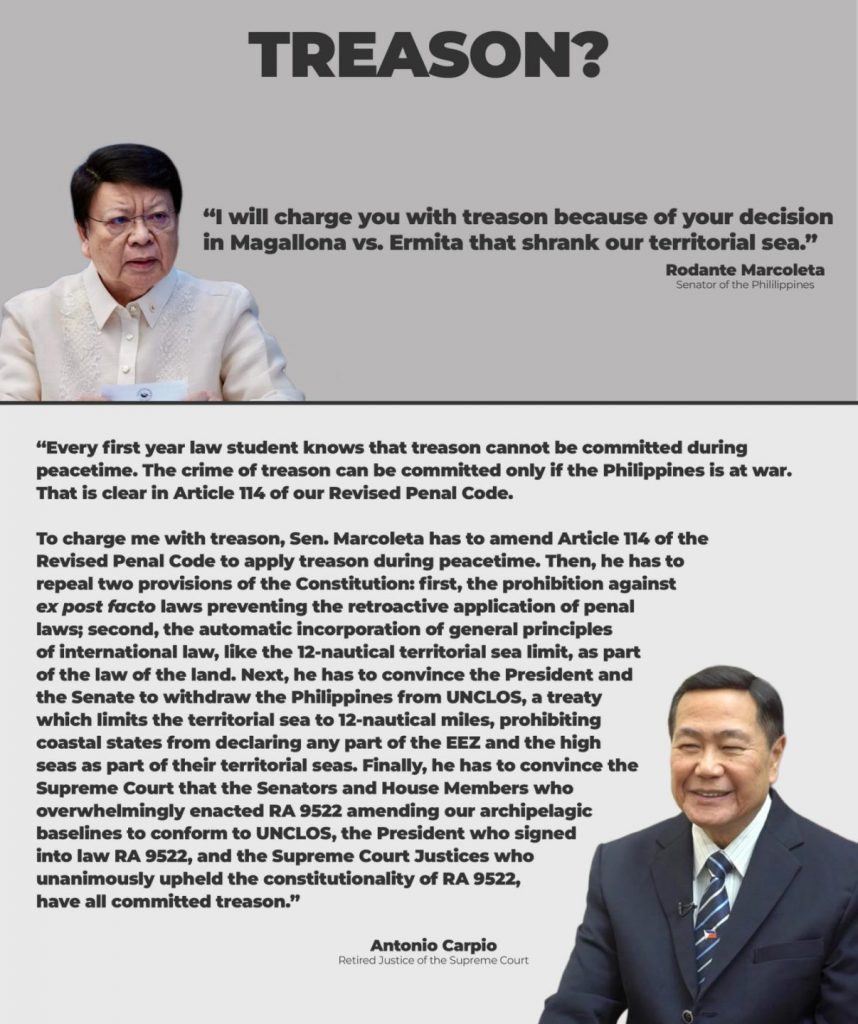
Retired Supreme Court Senior Associate Justice Antonio T. Carpio dismissed as baseless Senator Rodante Marcoleta’s threat to file a treason case against him over the 2011 Supreme Court ruling in Magallona v. Ermita, which upheld the constitutionality of Republic Act No. 9522, the Philippine Archipelagic Baselines Law.
In a recent interview, Carpio explained that under the Revised Penal Code, treason can be committed only in wartime.
“Treason can be committed only during wartime. We are not at war,” Carpio said, noting that Congress has not declared war against any country. He added that even if the law were amended to expand treason to peacetime, it could not be applied retroactively due to the constitutional prohibition against ex post facto laws.
Carpio further emphasized that the 2011 decision simply applied the Constitution and international law. The Philippine Constitution adopts the general principles of international law as part of the law of the land, including customary international law limiting the territorial sea to 12 nautical miles.
He noted that the Philippines is also a party to the United Nations Convention on the Law of the Sea (UNCLOS), which likewise provides that a state’s territorial sea cannot exceed 12 nautical miles. When a treaty is ratified, it becomes part of domestic law.
Republic Act No. 9522 was passed by Congress, signed by the President, and unanimously upheld by the Supreme Court. Carpio pointed out that the decision was concurred in by all members of the Court, with no dissent.
The petitioners in Magallona v. Ermita had argued that all waters within the 1898 Treaty of Paris lines should be treated as Philippine territorial sea. Carpio explained that such a position would have exceeded the 12-nautical-mile limit under international law and would have encroached on areas classified as exclusive economic zone (EEZ) or even high seas.
He added that adopting that position would have seriously undermined the Philippines’ arbitration case in The Hague challenging China’s nine-dash line in the West Philippine Sea. If the Philippines itself had maintained claims inconsistent with UNCLOS, the arbitral tribunal could have dismissed the case under the principle that a party coming to court must come with “clean hands.”
Carpio also noted that several countries, including the United States and Australia, had previously objected to any interpretation of the Treaty of Paris lines as defining Philippine territorial sea beyond internationally recognized limits.
He stressed that the 2011 ruling aligned Philippine law with UNCLOS and customary international law — a legal position that later strengthened the country’s successful arbitration case.
Addressing concerns that repeated accusations could create public confusion, Carpio said it is necessary to respond and clarify misconceptions.
“We cannot just sit down and do nothing when people mistake the facts and the law,” he said.