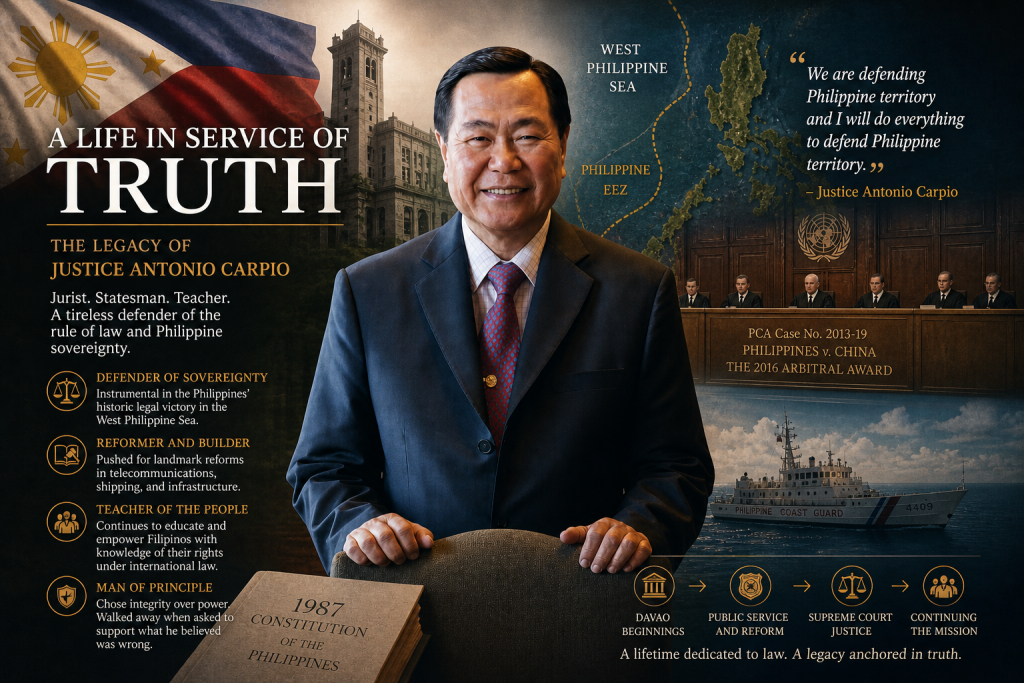
There are public figures who leave footprints. Then there are those who leave maps. In Episode 4 of #JustTheTruth, retired Supreme Court Senior Associate Justice Antonio Carpio emerges not merely as a legal mind—but as a steady compass in turbulent national waters.
The conversation peels back the robe and reveals the man: a boy from Davao who would rise through Ateneo and UP Law, not chasing prestige but sharpening purpose. His story is not built on spectacle. It is built on discipline, intellectual rigor, and a quiet, unyielding fidelity to the law.
- Rooted beginnings: Born and raised in Davao City, shaped by early education and a strong academic foundation.
- Relentless pursuit of excellence: Graduated from UP Law as valedictorian, carrying forward a lifelong commitment to legal mastery.
- A builder, not just a thinker: Established his own law firm, then moved seamlessly between private practice, executive service, and the judiciary.
Yet what defines Carpio is not just where he has been—but what he stood for when it mattered.
In government, he helped dismantle monopolies that once strangled Philippine telecommunications, opening doors to connectivity that today’s generation takes for granted. He pushed for reforms in shipping and infrastructure, quietly engineering systems that would later power economic growth.
But it is in moments of resistance where his character is most clearly drawn.
When asked to support constitutional changes he believed were ill-timed and self-serving, he chose principle over proximity to power. He walked away—not in protest, but in conviction.
On the bench, his legacy is etched into jurisprudence that strengthened—not weakened—the Philippines’ legal standing in the West Philippine Sea. Contrary to critics, Carpio’s work ensured that the country approached international arbitration with “clean hands,” aligning domestic law with global standards and ultimately securing a historic legal victory.
- Defender of sovereignty: Advocated the only viable battlefield—international law—against stronger powers.
- Teacher of truth: Continues to educate the public on maritime rights, treating the Filipino people as his sole client.
- Guardian of integrity: Repeatedly demonstrated that law, when anchored in principle, becomes a shield—not a tool.
Even in retirement, Carpio rejects the comfort of silence. His voice remains firm: the law must be understood, defended, and lived. Not selectively. Not conveniently. But fully.
In an era crowded with noise, his message cuts through with surgical clarity:
Truth does not bend to power. Power must answer to truth.
And perhaps that is the quiet brilliance of Justice Carpio. He did not merely interpret the law—he insisted that it remain worthy of trust.